

Predictive Planning: How AI and Scenario Planning Made Strategy Continuous.
The book that defines predictive planning as a leadership discipline — not a software feature, not a forecasting upgrade, not a futurist narrative. A practitioner-grade framework for the executive layer of an AI-native operating environment.
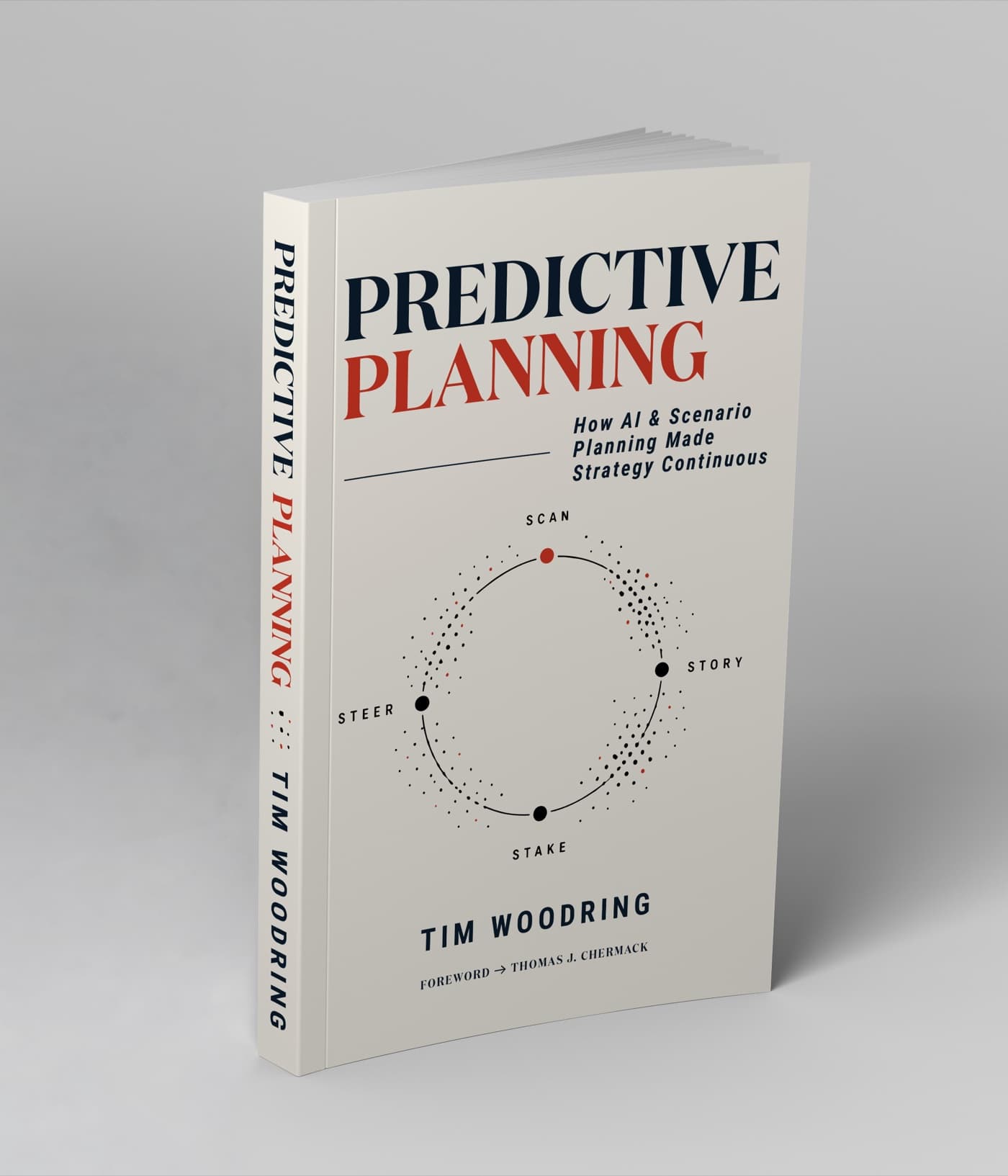
Your competitors are buying predictive planning software. Nobody has written the strategy that goes with it.
Scenario planning was invented for a pre-AI world — slow-moving, expert-dependent, episodic. The tools have changed radically. The methodology has not caught up. Meanwhile, enterprise software vendors are seeding "predictive planning" as a vocabulary into every CFO and COO in the Fortune 500, with no strategic framework behind the term. This book defines predictive planning as a leadership discipline — a practitioner-grade framework executives can actually use in the operating environment they actually have.
The foreword is by Thomas Chermack — author of Scenario Planning in Organizations, the standard text on scenario planning methodology. The discipline this book defines builds on the foundation he wrote. He opens it.
Kindle $9.99 · Paperback $19.99 · Hardcover $29.99 · Free on Kindle Unlimited
Read the Author’s Note — On AI in the Loop →
Read it? A short Amazon review is the most useful thing you can do for an independent book.
The Introduction and Chapter 1, free — enough to know whether the discipline is for you. We’ll email the PDF.
Sources & Ingestion
External and internal sources flow through adapters, a governance gate, and an extraction layer before they reach the math contract on the facing page.
Lattice, Modules & Decisions
The math contract composes signals into interpretive surfaces and drives the four decision types that close the Loop.
Raw Signals & Composites
The upstream half of the composition surface — raw signals fan into named composites and into the steward's own.
Steward-Built → Generated Scenario
The synthesis half — the same scoring engine that powers ranking, probability, and personalization writes the scenario.
Fourteen chapters. Three parts. One loop.
An introduction, fourteen chapters in three parts, a conclusion, and two appendices. Readable straight through for the framework, or referenced chapter by chapter as the discipline is installed.
- —Introduction — The Plan Was Wrong by April
An eighty-four-page operating plan, approved by the board in November, operationally false by the second week of March.
- 01The End of Annual Planning
The 142-slide offsite ritual — and the Cycle Audit, two clocks that show why the plan's calendar can no longer keep up with the world's.
- 02What AI Actually Changed
Two executives, one Tuesday. What collapsed, what didn't, and the AI/Human Split that keeps judgment where it belongs.
- 03Prediction Markets — The New Signal Layer
Kalshi, Polymarket, and market-implied probability as a checkable input to the scenario set.
- 04Why Software Won't Save You
The demo room is convincing. The discipline is what the demo assumes you already have.
- 05Predictive Planning, Defined
The full architecture of the discipline — and Woodring's Loop, the four-phase cycle the rest of the book installs.
- 06Scan — Building a Signal Layer
A live intake of system data, paid feeds, and human signal — one signal traced end to end, from public source to the steward's morning read.
- 07Story — Scenarios That Earn Their Keep
Three named scenarios with indicator sets that make them accountable — and the composition surface that writes them.
- 08Stake — Deciding Under AI Acceleration
The Stake Sizing Matrix — scenario, size, reversibility, conviction — and the conversation it forces before the commitment is made.
- 09Steer — The Continuous Adjustment
The Convergence Review — scenarios moving between columns, stakes pressed, held, or unwound in the same meeting.
- 10AI as Planning Partner, Not Oracle
Where the model adds leverage, where it actively misleads, and how to keep both straight.
- 11Building the Predictive Planning Team
Eight roles, four phases, a single Accountable per cell — the Loop RACI, and why the org chart has to move with the discipline.
- 12Killing the Annual Cycle
The 18-Month Sunset — four phases, named milestones, and the four political problems that run in parallel.
- 13The Prepared Organization
The Maturity Read — four phases by four stages, Absent to Compounding — and a Monday morning that doesn't feel like one.
- 14Choosing a Platform
The chapter Chapter 4 owes you — how to buy software for the discipline without mistaking it for the discipline.
- —Conclusion — What to Do Monday
Most strategy books are read and not installed. The first moves that close the gap.
- AAppendix A — The Practice: Installing Woodring's Loop
The installation manual — the Loop, step by step, in your own organization.
- BAppendix B — The Predictionist: A New Vocation
The role formalized — what the practitioner of continuous foresight is called, and what the chair requires.
The book also names a new vocation — the Predictionist — formalized in Appendix B. The Predictive Planning Institute is building the certification at /certification.
Read the book. Then keep the Loop running.
The newsletter is what comes after the last page — long-form essays extending the discipline, roughly weekly. No funnel, no sequence. Reply anytime.