

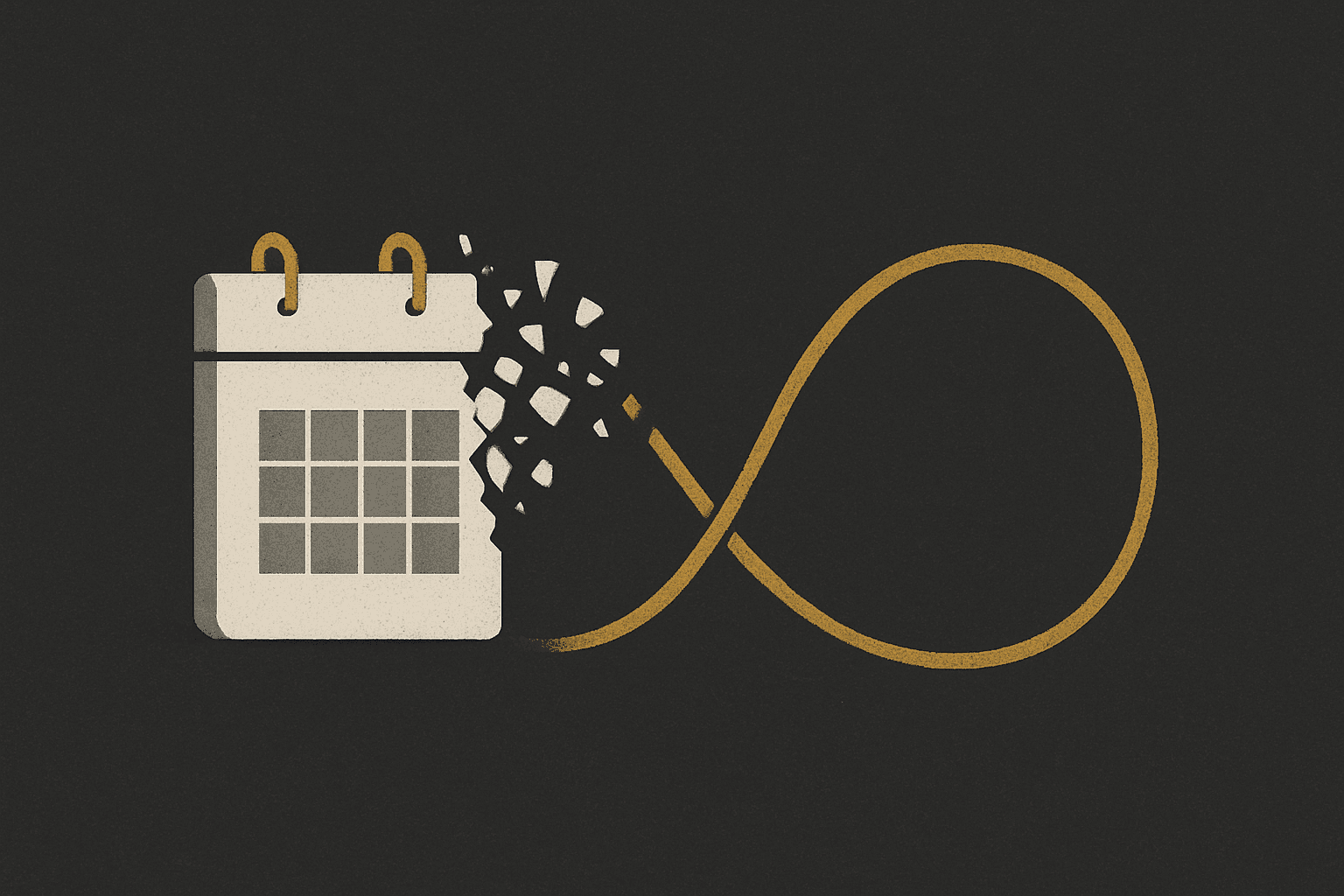
Picture the offsite. Two days, eleven executives, a 142-slide deck titled FY27 Strategic Plan — Working Session. Pages of macro outlook bought from a research subscription in August, last year’s plan with deltas in red, regional growth assumptions color-coded by confidence band, functional sub-plans each built by a director who spent six weeks gathering inputs from the layer below. It is a serious document. It is also, by any honest measure, the same document that was produced last year, and the year before that. The variables shift. The shape does not.
The plan goes to the board in November. It gets approved, cascaded down in January, tracked monthly, reforecast in April and again in July, and replaced in October by the FY28 version — which looks almost exactly like this one. The pattern is not stupid. It is the inheritance, the thing every executive in the room was trained to produce by every business school they attended and every CFO they reported to. The problem is not the document. The document was built for a world that has stopped existing.
The modern annual planning cycle is roughly sixty years old — templated on Jack Welch’s GE and copied into every Fortune 500 finance function since. It worked because it lined up with three things that held still. The fiscal year was a sensible unit of measurement, because labor costs, raw materials, customer demand, and capital availability all moved at roughly fiscal-year speed. A serious competitor took five to seven years to build a manufacturing footprint. A regulatory change took two years from comment period to enforcement. The annual plan did not need to anticipate fast change, because fast change was rare. The cycle was honest. It described the world it lived in.
That world is gone, and three forces killed it. The first is the collapse in the cost of running a scenario — AI has dropped the unit cost of a pressure-tested view of the future by close to an order of magnitude in three years. The second is environmental velocity: the half-life of a strategic assumption has compressed across every dimension that matters. Tariff regimes shift inside a quarter. Interest rates ran from near-zero to over five percent and back toward four inside three years. The third is software-defined competition — a rival no longer needs a plant, just an engineering team and a wedge, and the window between no one has heard of them and they’re in our customer’s RFPs now measures in quarters, sometimes months.
Here is the sharp version. Every annual plan carries a half-life — the interval over which its core assumptions stay operationally true. In 1985 that half-life was probably eighteen months. In 2005, twelve. Today it is closer to four. When the half-life of the plan drops below the cycle that produced it, the plan is structurally obsolete on the day it is approved. The November sign-off has a built-in expiration date of roughly March. Everything the organization does between March and the next October replan runs on a plan whose own assumptions the people in the room would no longer defend if asked. That is not an execution failure. It is a design failure of the cycle.
The honest people inside large organizations have known this for a while, and the partial fixes are not stupid. Rolling forecasts compress the cadence at which numbers get updated — but they update the answer to the same question more often, they don’t change the question. OKRs tighten alignment — but they’re internally focused and assume the strategy is right, so when the environment moves they just make you more efficient at executing the wrong plan. Agile shortens feedback loops — but it was scoped to product, not strategy, and has no serious answer for whether the goal itself should change. FP&A modernization — Anaplan, Pigment, Workday Adaptive — upgrades the infrastructure but runs the same process with prettier data. It is the same plan.
Hold the four fixes side by side and notice what they share. Each accepts the basic shape of the legacy model and improves a single dimension of it. The shape — annual strategic intent, quarterly cadence, functional sub-plans rolling up, executive review against variance — stays intact in all four. The fixes orbit the cycle. They do not replace it. That is why the CFO running a rolling forecast, an Anaplan deployment, a quarterly OKR rhythm, and an agile transformation still feels like the company is reacting. A competitor announces a category-redefining product, and the whole stack of fixes produces the same answer the legacy plan would have: we’ll work this into the next reforecast.
Want proof the cycle is the problem and not its execution? Run the Cycle Auditon your own organization in the next thirty days. Pick three real strategic decisions with money attached from the last two years. For each, mark four dates: when the underlying conditions first became visible to anyone in the company, when the executive conversation actually started, when the decision was formally made, and when the resources moved. That span is your decision cycle. Now map how often the conditions themselves have shifted — that is your environment’s change cycle. Hold the two timelines next to each other. If your decision cycle is longer than the interval at which your environment moves, you are reacting. The audit doesn’t tell you what to do. It makes the gap impossible to deny.
You can speed the calendar all you want. Move from annual to quarterly to monthly to weekly reviews. If the discipline running underneath is still track to plan, the speed gain is mostly noise — you produce more frequent variance reports, not more frequent strategic decisions. The quarterly reforecast asks how are we tracking against what we said? It does not ask should what we said still be what we say? Those are different questions, and the second is the one the environment is now demanding, on a cadence the annual cycle has no mechanism to support.
What replaces annual planning is not a faster version of the same thing. It is a different discipline — built for continuous operation, structured around live signal-sensing instead of episodic commitment, designed to convert weak signals into resource decisions on the cadence the environment actually permits. That discipline has a name and a shape: Woodring’s Loop— Scan, Story, Stake, Steer. Scan maintains a live signal layer. Story turns signals into a small set of pressure-tested scenarios, refreshed quarterly. Stake allocates resources against that scenario set continuously, in short monthly reviews that replace the November plan-approval as the heartbeat of the company. Steer stops treating in-year adjustments as deviations from a plan and starts treating them as the normal mechanics of how strategy works.
Installing the Loop is the easier half. The harder half is retiring the cycle it replaces — because you cannot run two operating systems forever, and the annual cycle has too many constituencies to walk away from casually. It owns ninety days of senior attention a year, the largest line in the consulting budget, and the organization’s primary forward-looking conversation with its board. The companies that have actually done it — Ford under Mulally is the closest historical analogue — named the retirement of the legacy cycle as the explicit objective at the top of the transition, not a downstream consequence. Run the Cycle Audit first. Once the gap is undeniable, the case for a continuous discipline stops being a theory and starts being the obvious next move.